
Cloud-Native vs On-Premise is no longer a future debate—it’s a decision shaping how businesses compete, scale, and stay secure in 2026. Cloud-Native vs On-Premise determines whether your technology becomes a growth engine or a bottleneck.
With rising cloud costs, tighter security expectations, and the emergence of edge computing, choosing the right infrastructure requires clarity—not buzzwords. This guide breaks down what really matters so you can build systems that are fast, resilient, and ready for what’s next.
Understanding the Core Difference: Cloud-Native vs On-Premise
Before comparing benefits, it’s important to understand what fundamentally separates cloud-native from on-premise infrastructure.
What Is Cloud-Native Architecture?
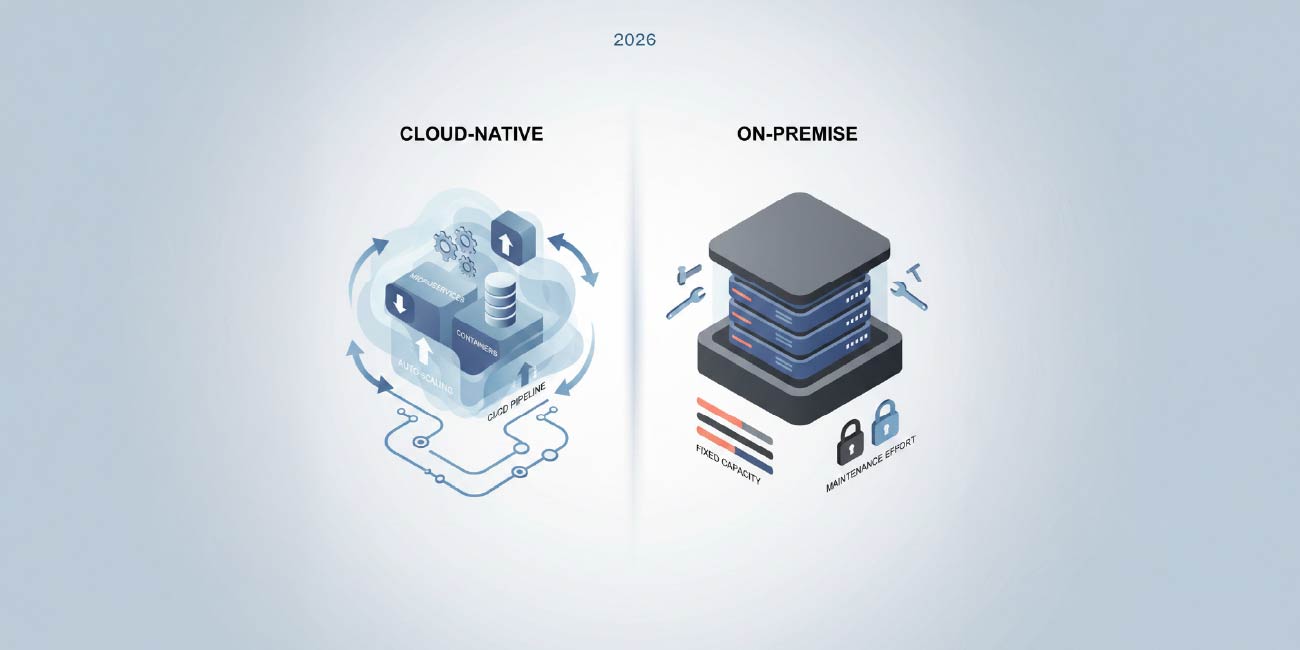
Cloud-native refers to applications and systems designed specifically to run in the cloud, not simply moved from traditional servers. These systems are built using modern development principles such as:
- Microservices-based architecture
- Containers and orchestration tools (like Kubernetes)
- Serverless computing models
- Continuous integration and deployment (CI/CD)
Cloud-native applications are modular, resilient, and scalable by design, making them ideal for fast-changing digital environments.
What Is On-Premise Infrastructure?
On-premise infrastructure involves hosting applications and data within physical servers owned and managed by the organization. Everything—from hardware procurement to security patches—is handled internally.
This approach offers maximum control but also places full responsibility on internal IT teams for performance, security, and scalability.
Cloud-Native vs On-Premise: Cost Models Explained
Cost remains the biggest source of confusion when comparing cloud-native vs on-premise.
Cloud-Native Cost Structure
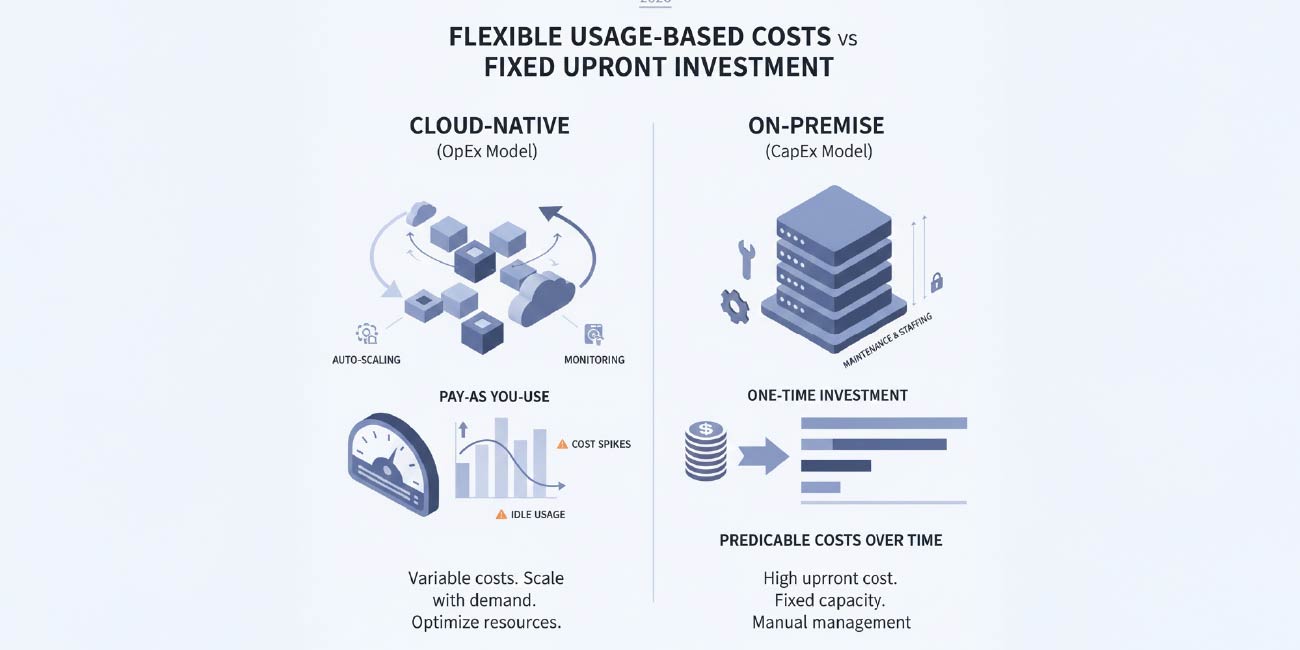
Cloud-native follows a pay-as-you-go operational expense (OpEx) model. Businesses pay only for the resources they consume.
Advantages
- No large upfront hardware investment
- Faster setup and deployment
- Easy scaling without capital risk
Challenges
- Costs can increase rapidly without monitoring
- Idle resources lead to wasted spend
- Requires active cost optimization tools
2026 Reality: Cloud is not automatically cheaper—efficient usage is the key.
On-Premise Cost Structure
On-premise infrastructure operates on a capital expense (CapEx) model, requiring significant upfront investment.
Advantages
- Predictable long-term costs
- No recurring usage-based charges
- Hardware can be depreciated over time
Challenges
- High initial setup cost
- Ongoing maintenance and staffing expenses
- Difficult to scale quickly
Best suited for: Organizations with stable workloads and long-term infrastructure planning.
Security Comparison: Cloud-Native vs On-Premise in 2026
Security concerns remain one of the biggest barriers to cloud adoption.
Cloud-Native Security in 2026
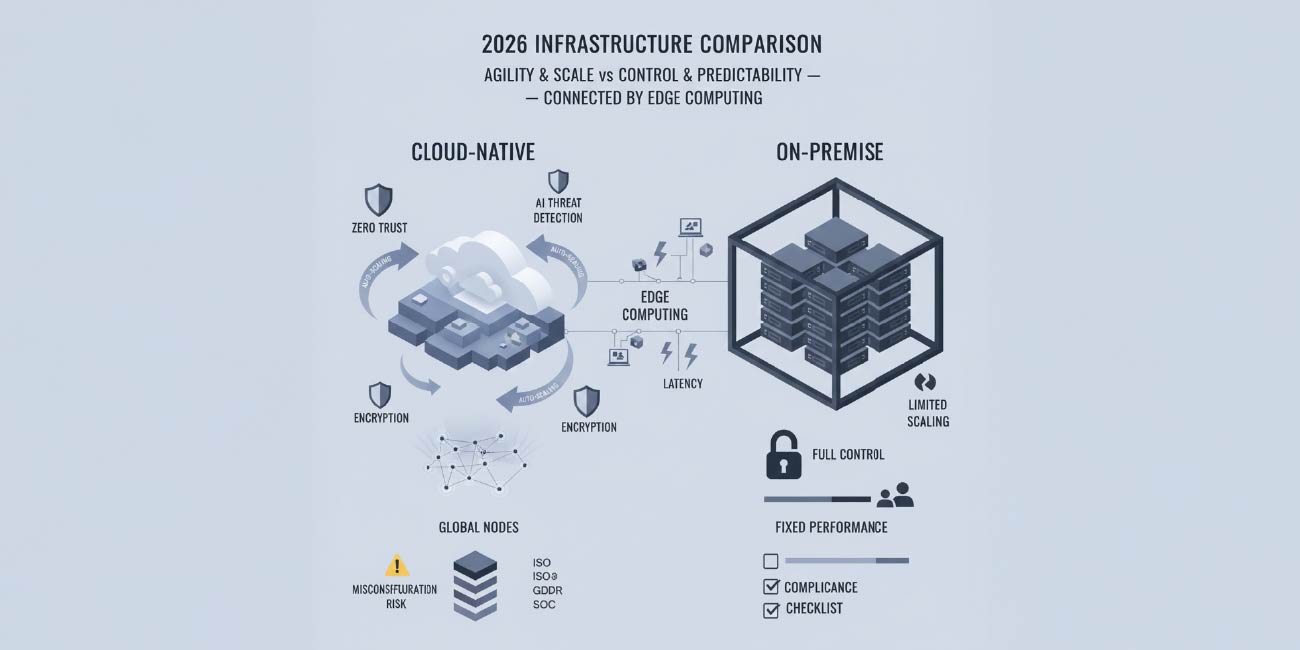
Major cloud providers now offer enterprise-grade security features, including:
- Zero Trust security models
- AI-powered threat detection
- Automated compliance and audits
- Data encryption by default
However, most cloud security incidents occur due to misconfigurations, not provider failures.
On-Premise Security Strengths
On-premise environments provide:
- Full control over data access
- Easier data residency compliance
- Custom security policies
The downside is that security depends entirely on internal expertise, which can be costly and difficult to scale.
Key Insight: Cloud-native security is often stronger—but only when implemented correctly.
Scalability and Performance: A Clear Difference
Scalability in Cloud-Native Systems
Cloud-native platforms scale automatically based on demand.
- Handle traffic spikes effortlessly
- Enable global reach within minutes
- Ideal for seasonal or unpredictable workloads
This makes cloud-native the preferred choice for SaaS platforms, eCommerce, and digital services.
Scalability in On-Premise Systems
On-premise scaling requires:
- Hardware upgrades
- Procurement cycles
- Downtime during expansion
This makes it less flexible in fast-growth scenarios.
Winner: Cloud-native leads significantly in scalability and speed.
Edge Computing: The Missing Link in the Debate
What Is Edge Computing?
Edge computing processes data closer to the user or device, instead of sending everything to a centralized cloud or data center.
Why Edge Computing Matters in 2026
- Ultra-low latency for real-time applications
- Reduced bandwidth costs
- Improved performance for IoT and AI systems
Cloud-Native + Edge: The Future Architecture
Modern systems increasingly combine:
- Cloud-native backend services
- Edge nodes for local processing
This hybrid approach delivers the speed of on-premise with the scalability of cloud-native systems.
Use Cases
- Smart manufacturing
- Autonomous vehicles
- AR/VR applications
- Real-time healthcare systems
Compliance and Regulatory Considerations
Cloud-Native Compliance
Cloud providers support compliance with standards such as:
- ISO
- SOC
- GDPR
- HIPAA
However, businesses remain responsible for how data is configured and accessed.
On-Premise Compliance
On-premise systems simplify compliance for industries with strict regulatory requirements but require extensive internal audits and controls.
When to Choose Cloud-Native vs On-Premise
Choose Cloud-Native If You Need
- Rapid innovation
- Elastic scalability
- Global deployment
- Faster time to market
Choose On-Premise If You Need
- Full infrastructure control
- Data sovereignty
- Stable and predictable workloads
- Offline or low-connectivity operations
Hybrid and Multi-Cloud: The 2026 Reality
Most enterprises in 2026 are not choosing one over the other. Instead, they adopt hybrid or multi-cloud architectures to balance cost, performance, and compliance.
Hybrid models allow:
- Sensitive data to stay on-premise
- Scalable workloads to move to the cloud
- Edge computing for low-latency needs
Cloud-Native vs On-Premise in 2026
The Cloud-Native vs On-Premise decision is no longer about technology alone—it’s about aligning infrastructure with business strategy.
Cloud-native offers agility and innovation, while on-premise provides control and predictability. The most successful organizations in 2026 are those that combine both intelligently, using hybrid and edge-driven architectures.
Get a personalized cloud, on-premise, or hybrid roadmap aligned with your business goals.
🔗 Book a consultation with 18Pixels
FAQs:
Cloud-native refers to applications built specifically for cloud environments using scalable, modular architectures.
On-premise infrastructure runs on physical servers managed and maintained within an organization.
Cloud-native can be cost-effective for variable workloads, but long-term costs depend on usage optimization.
Yes, when properly configured, cloud-native platforms offer enterprise-grade security.
Don’t stop here—discover more in our latest blog –
Full-Stack Web Development in 2025: Technologies Every Business Should Know
Generative AI in Software: Opportunities, Risks, and 2026 Best Practices
Mobile-First or Mobile-Last? Why 62% of Your Traffic Demands a Mobile-Optimized Website
Post Views: 450