
In the rapidly accelerating digital age, the mobile app landscape is undergoing a profound transformation. What was once considered cutting-edge is now becoming the baseline, and at the forefront of this evolution are AI in mobile apps.
If you’re a business, entrepreneur, or developer looking to carve out a significant presence in the mobile market, integrating Essential AI Features into your next application is no longer an option – it’s a strategic imperative.
This comprehensive guide will delve into the critical role of AI in mobile apps, explore the most impactful AI functionalities, and highlight how these innovations are redefining user expectations and business success.

Why AI in Mobile Apps is the Unstoppable Force Driving Innovation
The shift towards intelligent, intuitive, and highly personalized mobile experiences is undeniable. Users no longer merely seek functionality; they demand an app that understands their needs, anticipates their desires, and simplifies their lives. This is precisely where AI in mobile app development shines.
- Enhanced User Experience (UX): AI algorithms analyze user behavior, preferences, and historical data to deliver hyper-personalized content, services, and interactions, making every touchpoint feel unique and relevant.
- Unprecedented Automation: From routine customer service queries to complex data analysis, AI streamlines processes, reduces the need for manual intervention, and frees up human resources for more strategic tasks.
- Actionable Insights: AI’s ability to process and interpret vast datasets provides businesses with invaluable insights into user patterns, market trends, and operational efficiencies, empowering data-driven decision-making.
- Competitive Edge: In a saturated app market, AI-powered apps stand out. They offer a superior user experience, foster deeper engagement, and ultimately drive higher retention rates compared to their non-AI counterparts.
The integration of AI isn’t just about adding a fancy feature; it’s about fundamentally rethinking how users interact with technology and how businesses deliver value.
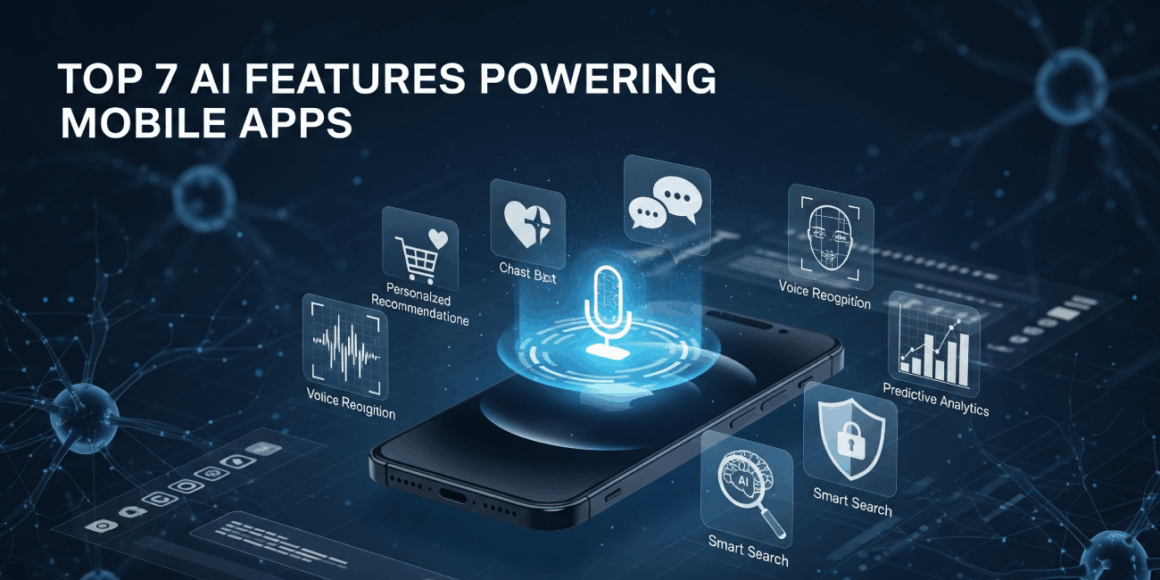
Top 7 Essential AI Features Revolutionizing Mobile App Development
To truly build a next-generation mobile application, consider incorporating these cornerstone AI mobile app features:
1. Personalized Recommendations: The Engine of Engagement and Conversion
At its core, personalization is about making the user feel understood and valued. AI algorithms, through techniques like collaborative filtering and content-based filtering, analyze a user’s past interactions, purchase history, Browse patterns, and even real-time behavior to suggest relevant products, services, articles, videos, or even connections.
- Impact: Significantly boosts engagement, increases conversion rates, improves user satisfaction, and fosters brand loyalty.
- Examples: E-commerce product suggestions (Amazon, Myntra), content recommendations (Netflix, Spotify), news feed curation (Facebook, Google News).
2. Chatbots and Virtual Assistants: 24/7 Intelligent Support
Gone are the days of rigid, frustrating customer support. AI-powered chatbots and virtual assistants offer instant, round-the-clock support, answering common queries, guiding users through processes, and even processing transactions. Leveraging Natural Language Understanding (NLU), these AI entities can comprehend complex user intents and respond in a natural, conversational manner.
- Impact: Improves customer service efficiency, reduces operational costs, enhances user satisfaction with immediate responses, and provides valuable insights into common user issues.
- Examples: Customer support bots on e-commerce sites, virtual assistants like Siri, Google Assistant, and Alexa integrated into various apps.
3. Voice Recognition & Natural Language Processing (NLP): The Power of Conversational AI
Voice technology has moved beyond simple commands. Voice Recognition (Speech-to-Text) allows users to interact with apps hands-free, while Natural Language Processing (NLP) enables the app to not just hear but understand the nuances of human language, including sentiment, intent, and context.
- Impact: Enhances accessibility, offers a more intuitive and convenient user interface, improves search functionality, and facilitates hands-free operation in various scenarios (e.g., driving, cooking).
- Examples: Voice search in Google Maps, voice-controlled smart home apps, dictation features in messaging apps.
4. Image & Facial Recognition: Visual Intelligence for Enhanced Interaction and Security
From unlocking your phone with a glance to categorizing your photo library, AI-driven Image and Facial Recognition are pervasive. These technologies use deep learning models to identify objects, people, places, and even emotions within images and videos.
- Impact: Strengthens app security through biometric authentication, enhances user experience with intelligent photo organization, powers augmented reality (AR) experiences, and enables advanced visual search.
- Examples: Face ID on smartphones, Google Photos’ object recognition, Snapchat filters, security cameras with person detection.
5. Predictive Analytics: Anticipating User Needs and Market Trends
Predictive Analytics harnesses AI and machine learning to analyze historical data and forecast future outcomes. For mobile apps, this means anticipating user churn, predicting popular products, optimizing marketing campaigns, and even foreseeing system failures.
- Impact: Empowers proactive decision-making, optimizes resource allocation, improves personalization strategies, and helps businesses stay ahead of market shifts.
- Examples: Ride-sharing apps predicting surge pricing, e-commerce apps predicting future purchases, financial apps offering personalized budget advice based on spending habits.
6. AI-Powered Search: Smarter, More Contextual Discoverability
Traditional search often relies on exact keyword matches. AI-powered Search goes beyond this, understanding the user’s intent, context, and even providing results based on voice or image input. It learns from past searches and user behavior to deliver increasingly relevant and accurate results.
- Impact: Significantly improves content discoverability, reduces user frustration, enhances overall app usability, and drives engagement with relevant information.
- Examples: Semantic search in e-commerce apps, visual search (e.g., Pinterest Lens), conversational search.
7. Fraud Detection and App Security: Fortifying the Digital Frontier
In an era of increasing cyber threats, AI strengthens app security by continuously monitoring user behavior and network traffic for anomalies. Machine learning algorithms can detect unusual login attempts, suspicious transactions, or malicious activity in real-time, providing robust protection against fraud and data breaches.
- Impact: Protects user data and privacy, builds user trust, reduces financial losses due to fraud, and ensures regulatory compliance.
- Examples: Banking apps flagging suspicious transactions, login systems detecting unusual access patterns, cybersecurity apps identifying malware.
Industries Thriving with AI App Integration
The transformative power of AI app development is being leveraged across a multitude of industries, driving efficiency, personalization, and new revenue streams:

- E-commerce: Personalized shopping experiences, intelligent inventory management, smart product recommendations, AI-powered customer service.
- Healthcare: AI chatbots for symptom assessment and appointment booking, personalized health monitoring, AI-driven diagnostics, and patient data analysis.
- Fintech: Robust fraud detection, algorithmic trading, personalized financial advising, credit scoring models, and secure payment processing.
- Education: Personalized learning paths, virtual tutors, automated assessment tools, adaptive content delivery, and progress tracking.
- Travel & Hospitality: Dynamic pricing, personalized travel recommendations, AI concierges, smart booking systems.
- Logistics & Supply Chain: Predictive maintenance for vehicles, optimized route planning, demand forecasting, automated warehouse management.
Build Smarter, More Engaging Apps with Essential AI Features
The journey into the future of mobile applications is inextricably linked with AI integration. As user expectations continue to soar, merely functional apps will no longer suffice. By strategically incorporating Essential AI Features, businesses and developers can craft mobile experiences that are not only highly engaging and intuitive but also inherently intelligent, secure, and scalable.
Whether you’re a burgeoning startup aiming to disrupt a market or an established enterprise seeking to redefine your digital presence, investing in AI app development is paramount. It’s an investment in a competitive edge, enhanced user satisfaction, and a future where your mobile app truly resides in the “pocket” of its users, offering unparalleled value and convenience. Embrace mobile app innovation and equip your next app with the smart app features that will set it apart in the ever-evolving digital landscape.
FAQs
What are the most essential AI features for modern mobile apps?
Key essential AI features include Personalized Recommendations, AI-powered Chatbots and Virtual Assistants, Voice Recognition & Natural Language Processing (NLP), Image & Facial Recognition, Predictive Analytics, AI-Powered Search, and advanced Fraud Detection & App Security.
Why is AI considered so important in mobile app development today?
AI is crucial because it significantly enhances the user experience through personalization, automates routine tasks, provides valuable data-driven insights, improves app efficiency and security, and ultimately gives mobile applications a significant competitive advantage in a crowded market.
Can small businesses and startups afford to integrate AI into their apps?
Absolutely. With the increasing availability of accessible AI development tools, open-source AI frameworks, cloud-based AI services (like AWS AI/ML, Google Cloud AI, Azure AI), and readily available APIs, integrating powerful AI functionalities into mobile apps is becoming increasingly feasible and cost-effective for businesses of all sizes, including startups.
How does AI improve app security and user privacy?
AI strengthens app security by employing sophisticated algorithms for fraud detection, real-time anomaly detection, behavior-based authentication, and threat analysis. While AI processes data, ethical AI development emphasizes data anonymization, encryption, and strict adherence to privacy regulations (like GDPR and CCPA) to protect user privacy.
What are the benefits of using AI-powered search in a mobile app?
AI-powered search goes beyond keyword matching to understand user intent and context, offering more relevant and accurate results. Benefits include faster information retrieval, support for voice and image search, improved user satisfaction, and increased engagement with app content or products.
Ready to elevate your mobile app with AI?
At 18Pixels, we help you integrate essential AI features to create smarter, more engaging user experiences.
👉 Contact 18Pixels and transform your app idea into an AI-powered success!
Don’t stop here—discover more in our latest blog –
18Pixels Nonprofit CRM Solutions
AI in E-commerce
10 Signs Your Shopify Store Isn’t Working — And How to Fix Them Fast
Post Views: 658