
n8n vs Zapier vs Make is one of the most searched workflow automation comparisons by businesses looking to reduce manual work and improve efficiency. n8n vs Zapier vs Make becomes especially important when companies must decide between ease of use, long-term scalability, and cost control.
With automation becoming a core part of digital transformation, selecting the wrong tool can lead to high recurring costs, limited flexibility, and data security concerns. This detailed comparison explains n8n vs Zapier vs Make so businesses can confidently choose the right automation platform.
What Is Workflow Automation and Why It Matters
Workflow automation refers to the use of software tools to automate repetitive tasks, integrate multiple applications, and streamline business processes. Instead of manually moving data between systems like CRM, marketing tools, accounting software, and internal databases, automation platforms handle these actions automatically.
For growing businesses, workflow automation reduces human error, saves time, and allows teams to focus on high-value work. However, the benefits depend heavily on the platform chosen, which is why understanding n8n vs Zapier vs Make is crucial before implementation.
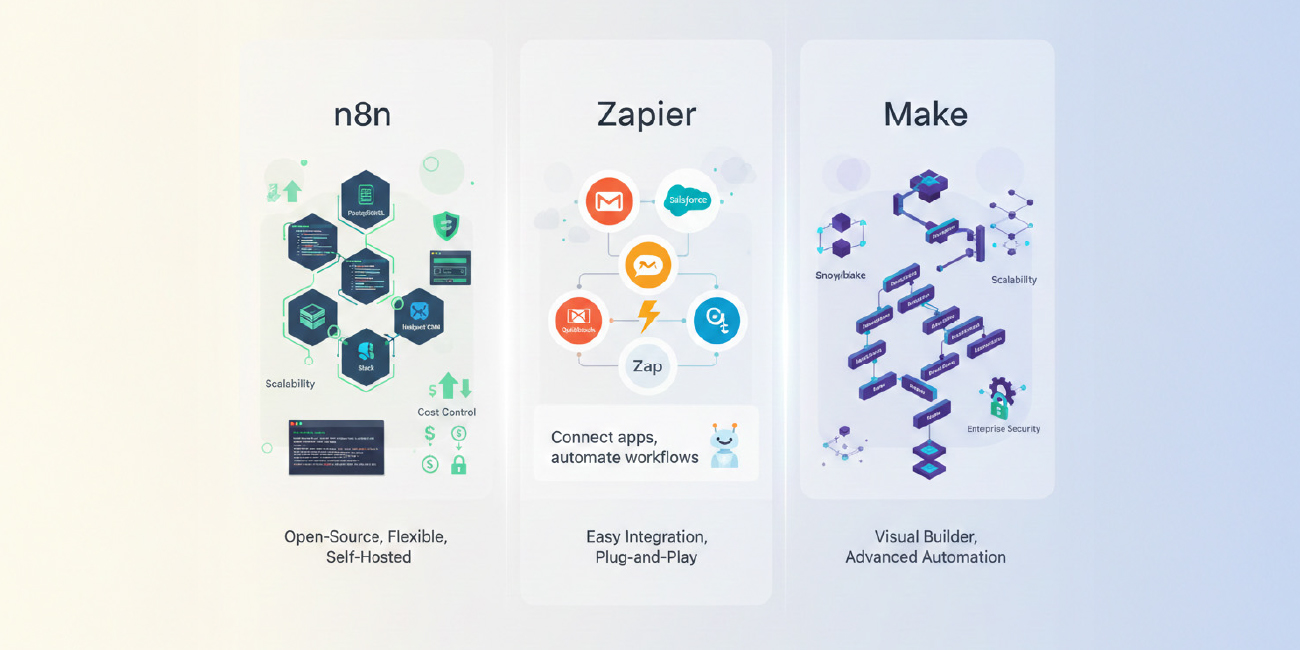
Overview of n8n, Zapier, and Make
n8n: Open-Source Workflow Automation for Full Control
n8n is a low-code, open-source workflow automation platform designed for organizations that need flexibility, customization, and complete control over their automation infrastructure. Unlike most SaaS tools, n8n can be self-hosted, meaning businesses retain ownership of their data and workflows.
n8n supports advanced logic, custom JavaScript, API integrations, and complex conditional flows. This makes it ideal for enterprises, SaaS platforms, and tech-driven companies that need automation beyond basic trigger-action workflows. While n8n has a learning curve, it offers unmatched scalability and cost efficiency for long-term use.
Zapier: Simple No-Code Automation for Fast Results
Zapier is a cloud-based, no-code automation tool built for simplicity and speed. It allows users to connect thousands of apps using basic trigger-and-action workflows, known as “Zaps.” Zapier is widely adopted because it requires no technical knowledge and can be set up in minutes.
However, Zapier’s simplicity also limits its flexibility. Complex logic, custom data handling, and advanced workflows are difficult or impossible to implement. Additionally, Zapier’s per-task pricing model can become expensive as automation usage grows, making it less suitable for large-scale automation.
Make (Integromat): Visual Automation with Advanced Logic
Make, formerly known as Integromat, is a cloud-based automation platform known for its visual workflow builder. It allows users to design complex scenarios with branching, loops, and data transformations, offering more flexibility than Zapier.
While Make is powerful, it still operates on a usage-based pricing model that charges per operation. For workflows involving large data volumes or frequent executions, costs can increase quickly. Make is best suited for mid-sized businesses that need more power than Zapier but are not ready for full self-hosted automation like n8n.
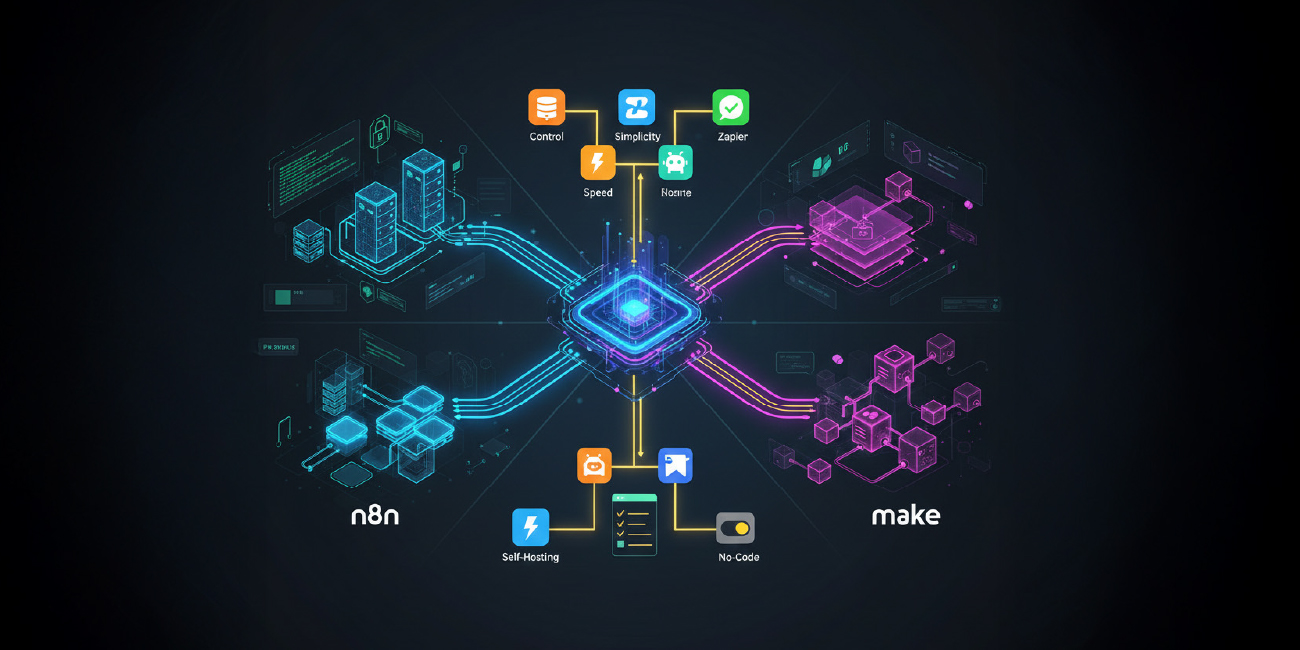
n8n vs Zapier vs Make: Ease of Use Explained
When comparing n8n vs Zapier vs Make, ease of use varies significantly. Zapier is the easiest to use, designed for non-technical users who want quick results. Make requires some technical understanding due to its visual logic-based interface. n8n has the steepest learning curve, as it is designed for developers or technically skilled teams.
However, ease of use should be evaluated alongside long-term needs. While Zapier is easy initially, it can become restrictive as workflows grow. n8n, though complex at first, provides long-term flexibility and scalability.
Workflow Complexity and Customization Capabilities
Zapier works best for simple, linear workflows with minimal logic. Make supports more advanced scenarios, including branching and error handling. n8n goes a step further by allowing fully customized workflows using code, APIs, databases, and custom integrations.
For businesses with complex systems, multiple data sources, or unique automation requirements, n8n provides a level of customization that Zapier and Make cannot match.
Hosting, Security, and Data Ownership
A major difference in n8n vs Zapier vs Make is data control. Zapier and Make are cloud-only platforms, meaning all data passes through their servers. This can raise compliance and security concerns for industries like finance, healthcare, and SaaS.
n8n allows self-hosting, enabling businesses to keep data within their own infrastructure. This makes n8n ideal for organizations with strict security policies, compliance requirements, or internal data governance standards.
Pricing and Cost Scalability
Zapier uses a per-task pricing model, which becomes expensive as automation volume increases. Make charges per operation, which can also scale unpredictably. Both models work for small usage but can become cost-heavy over time.
n8n offers a free self-hosted version and predictable pricing, making it far more cost-effective for high-volume and enterprise automation. This is a key reason why many companies eventually migrate from Zapier or Make to n8n.
Use Case-Based Tool Selection
Zapier is best for small teams, startups, and marketers who need quick, simple automations. Make suits operations teams and mid-sized businesses needing more advanced workflows without managing infrastructure. n8n is ideal for enterprises, SaaS companies, and organizations planning large-scale or long-term automation.
Choosing the right tool depends on current needs and future growth plans.
Why 18Pixels Recommends n8n for Scalable Automation
At 18Pixels, we work closely with businesses to design automation systems that scale efficiently. Based on our experience, n8n offers the best balance of flexibility, control, and cost savings for companies serious about automation.
We help clients implement self-hosted n8n solutions, migrate from Zapier or Make, and build secure, scalable workflows that reduce operational costs and increase efficiency.
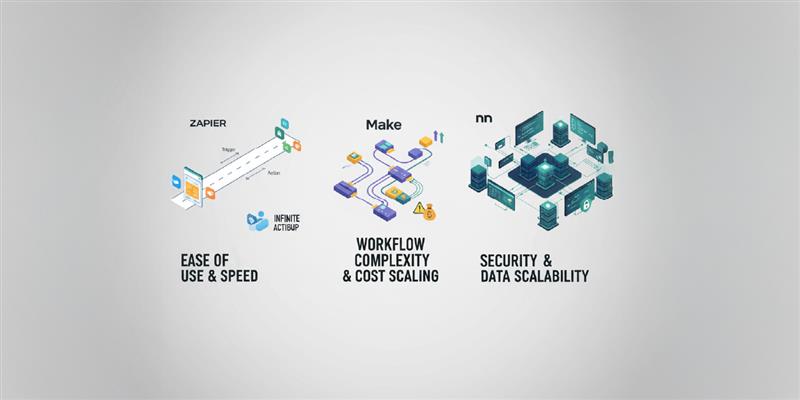
Final Thoughts: n8n vs Zapier vs Make
The decision between n8n vs Zapier vs Make depends on your business goals. Zapier offers simplicity, Make provides visual flexibility, and n8n delivers enterprise-grade power and scalability. For organizations planning long-term automation growth, n8n stands out as the most future-ready solution.
Cut manual work, boost productivity, and scale faster with tailored automation solutions.
Accelerate Your Growth — Let’s Build Your First n8n Workflow
FAQs:
The main difference between n8n vs Zapier vs Make is flexibility and scalability. Zapier is best for simple automations, Make offers visual complexity, while n8n provides full control with open-source, self-hosted automation.
Zapier is the best choice for beginners due to its no-code interface and easy setup.
Yes, n8n is better than Zapier for large businesses because it supports complex workflows, self-hosting, and predictable costs at scale.
Make allows visual workflow design with branching, loops, and advanced data handling, making it more flexible than Zapier.
n8n is the most cost-effective long-term solution because it does not charge per task or operation in self-hosted setups.
Yes, n8n can replace both Zapier and Make, especially for businesses needing advanced logic, data control, and scalable automation.
Yes, n8n is highly secure when self-hosted, allowing businesses to meet data privacy and compliance requirements.
18Pixels recommends n8n for businesses seeking scalable, secure, and cost-efficient workflow automation.
Don’t stop here—discover more in our latest blog –
Full-Stack Web Development in 2025: Technologies Every Business Should Know
Cloud-Native vs On-Premise: What You Really Need to Know in 2026
Mobile-First or Mobile-Last? Why 62% of Your Traffic Demands a Mobile-Optimized Website
Post Views: 460