

Data Privacy Compliance in 2026 is becoming a mission-critical priority for every organization as GDPR rules tighten, AI governance laws emerge, and global privacy frameworks expand. With new regulations rolling out across Europe, the US, India, and Asia, businesses must rethink how they collect data, train AI systems, automate decisions, and ensure compliance while still innovating at speed.
The 2026 Privacy Shift: Why This Year Is a Major Turning Point
2026 marks one of the biggest regulatory leaps in the last decade. What used to be “just GDPR compliance” has now expanded into a multi-layered ecosystem of AI rules, automated decision-making guidelines, consent frameworks, cross-border data laws, and real-time compliance audits.
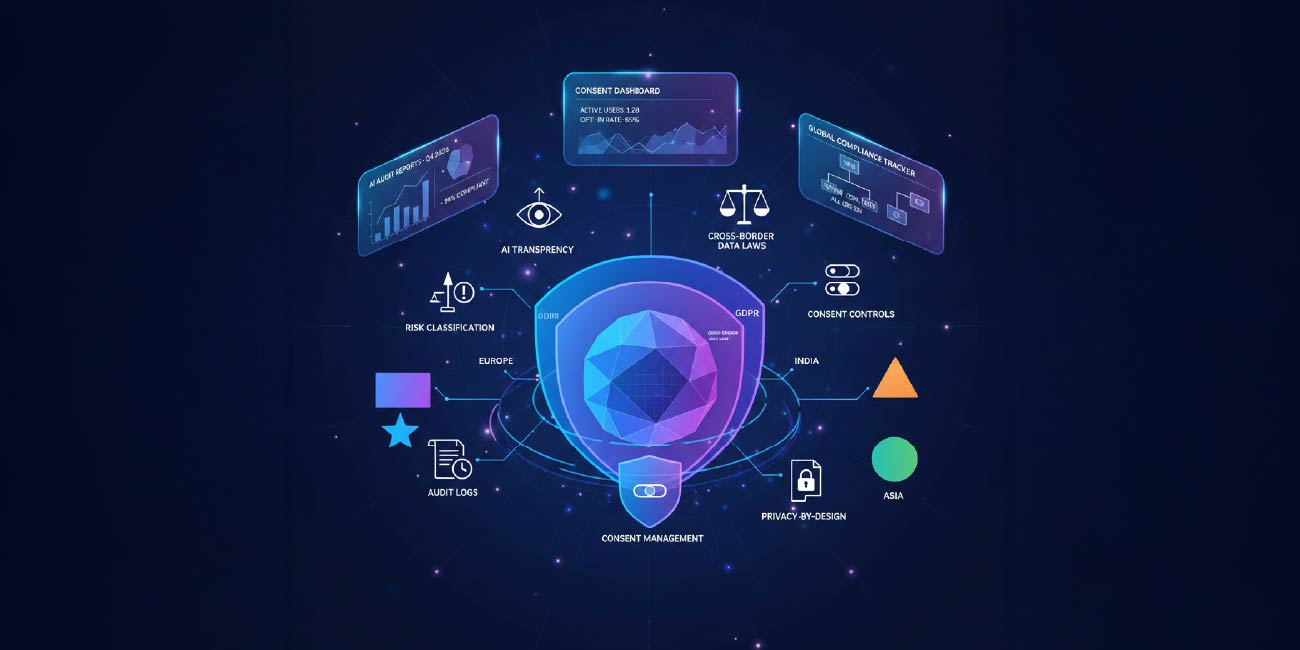
6 Mega Trends Shaping Data Privacy in 2026
- AI Governance Becomes Mandatory
With the EU AI Act and global AI ethics standards, every AI system must be transparent, traceable, and safe. - Expansion of GDPR Enforcement
Regulators are now focusing on AI profiling, behavioral data collection, algorithmic bias, and automated decision-making. - Stricter Cross-Border Data Transfers
US-EU Data Privacy Framework, new SCCs, India’s DPDP Act, and China’s PIPL require more documentation and security layering. - Privacy-By-Design Goes Mainstream
Every product feature must now show evidence of privacy controls built into the design, not added later. - AI Audits & Risk Classification Requirements
High-risk AI systems must maintain logs, testing data, validation reports, and transparency documentation. - User Consent Becomes Granular
“Broad consent” is no longer enough—users must be able to control how their data is used in AI training, analytics, and personalization.
New Regulations Businesses Must Prepare For in 2026
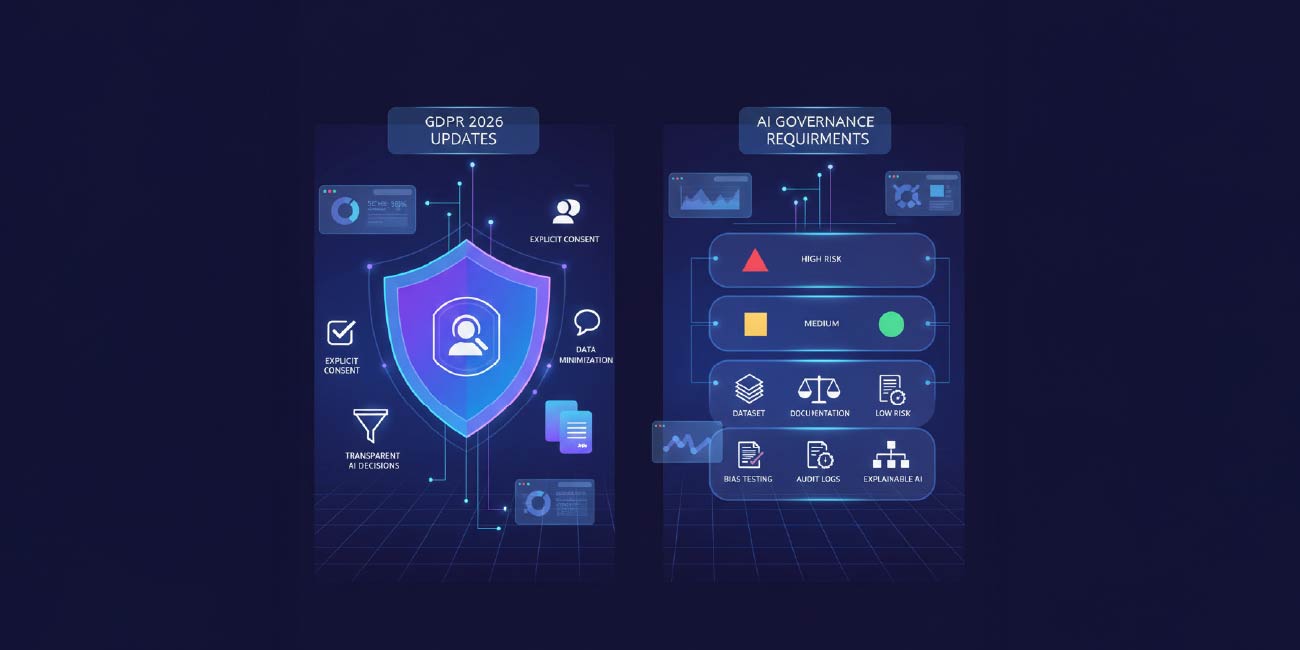
1. GDPR Updates & Automated Decision-Making Rules
GDPR has evolved significantly since 2018. Key updates impacting 2026:
- AI-driven profiling needs explicit consent
- Companies must explain how AI decisions work
- Data subjects can request “human review”
- Data minimization must extend to machine-learning data pipelines
- Clear documentation of training data sources
High-volume SEO keywords naturally included:
GDPR compliance, GDPR updates 2026, GDPR audit checklist, automated decision-making rules.
2. The Rise of AI Governance (EU AI Act + Global AI Standards)
AI governance is now one of the top global compliance concerns.
What AI Governance Requires in 2026
- Risk classification: high-risk, medium-risk, minimal-risk AI systems
- Dataset documentation for training + validation
- Explainable models for high-risk categories
- Bias testing & mitigation
- Audit logs for every AI decision
- Human oversight controls
- Security checks during model deployment

AI Systems Considered High-Risk
- Credit scoring
- Loan approvals
- HR screening tools
- Healthcare recommendations
- Predictive policing
- Insurance risk scoring
SEO keywords: AI governance framework, AI compliance, AI risk management, EU AI Act requirements.
3. Global Data Privacy Laws Changing the Landscape
Businesses operating globally must comply with a mix of powerful privacy laws.
India – Digital Personal Data Protection Act (DPDP Act 2023)
Full implementation continues through 2026 with strict rules:
- Consent-based data usage
- Purpose limitation
- Data fiduciary obligations
- Data localization for sensitive data
- Heavier penalties for misuse
US – CPRA, CPA, VCDPA, & More
The US now has a state-by-state privacy ecosystem, requiring:
- Clear opt-out systems
- Data transparency logs
- Consumer request workflows
China – PIPL
One of the world’s strictest laws, requiring:
- Security assessments for all cross-border data transfers
- Data localization for certain categories
- High consent standards

Brazil – LGPD Updates
Focus on:
- Sensitive data protection
- Higher consent requirements
- Stronger penalties
SEO keywords: data privacy laws 2026, global data protection regulations, DPDP Act compliance.
The Real Business Pain in 2026: Balancing Innovation With Compliance
Most companies now face a frustrating dilemma:
1: AI innovation slows because teams fear violating laws
Companies hesitate to adopt AI due to unclear regulations.
2: Data teams don’t know what’s “allowed”
Is personal data safe for training?
Does consent allow AI use?
What about third-party APIs?
3: Compliance & tech teams are not aligned
Legal says “don’t do it.”
Engineering says “we need data.”
Leadership wants faster digital growth.
4: Documentation is overwhelming
AI models require:
- Logs
- Testing data reports
- Bias checks
- Security validation
- Human oversight mechanisms
How 18Pixels Helps Companies Stay Compliant AND Innovative in 2026
18Pixels builds systems that marry AI innovation with full compliance across GDPR, DPDP, CPRA, and the EU AI Act.
1. AI Governance Framework Built Into Every Solution
18Pixels ensures:
- Model transparency
- Human-in-the-loop review for high-risk AI
- Bias & drift monitoring dashboards
- Audit-ready logs for every prediction
- Explainability layers for regulators
2. Privacy-By-Design System Architecture
Our engineering approach includes:
- Automated consent management workflows
- Data minimization layers
- Role-based access control
- Real-time data masking
- Encryption at rest + in transit
3. Secure AI Development Infrastructure
To ensure safe model training:
- Federated learning (AI trains without seeing raw data)
- Synthetic datasets for low-risk ML training
- Secure sandboxes for model experimentation
4. Cross-Border Data Compliance Made Simple
We implement:
- Data localization
- Transfer impact assessments
- SCCs (Standard Contractual Clauses)
- Country-specific data controls
This helps global brands operate confidently across EU, US, India, and APAC.
2026 Best Practices to Stay Ahead of Data Privacy Regulations
1. Adopt Privacy by Design From Day One
Make privacy a design decision, not a compliance checkbox.
2. Maintain an Always-On AI Governance Team
AI models must be continuously monitored to prevent drift, bias, or misuse.
3. Build a Transparent Data Inventory
Document exactly:
- What data you collect
- Where it goes
- How it’s used
- Who accesses it
4. Use Synthetic Data Wherever Possible
Reduces risk and avoids training models on sensitive information.
5. Implement Real-Time Consent Management
Allow users to modify or withdraw consent at any time.
6. Automate Compliance Reporting
Dashboards make audits faster and error-free.
Predictions: What Data Privacy Will Look Like by 2028
- AI Act enforcement will be global
- Algorithmic transparency will be mandatory
- Real-time AI auditability will become standard
- Consent management will be fully automated
- Corporations will use privacy-safe AI models by default
- Synthetic data will become the primary ML training method
FAQ
It refers to meeting updated GDPR laws, AI governance rules, and global data protection regulations governing personal data and AI systems.
Because unregulated AI can lead to bias, unfair decisions, data misuse, and legal penalties.
GDPR controls:
What data can be used
How profiling works
Explainability requirements
Accountability of models
By adopting privacy-first architecture, federated learning, synthetic data, and automated governance systems built by partners like 18Pixels.
Fintech, SaaS, EdTech, healthcare, insurance, logistics, and e-commerce—basically any sector using AI-driven decisions.
Don’t stop here—discover more in our latest blog –
Shopify Store Not Selling? How to Transform Visitors into Paying Customers
Global E-commerce in 2026: Multi-Currency, Multi-Language, Multi-Country Compliance
10 Signs Your Shopify Store Isn’t Working — And How to Fix Them Fast
Post Views: 1940