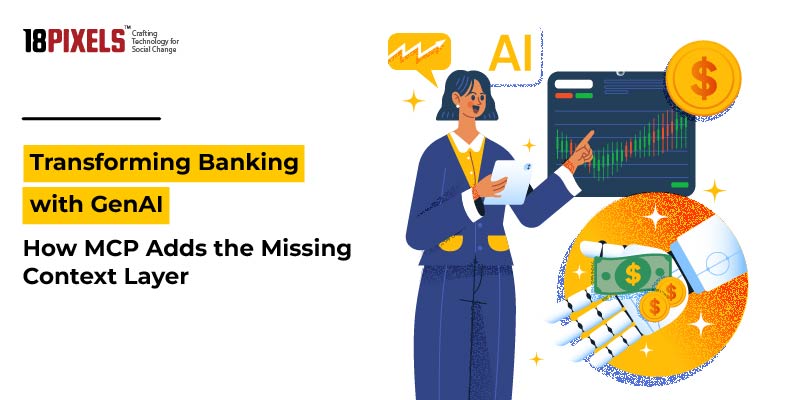

Generative AI in banking is delivering unprecedented returns—McKinsey estimates $200 billion to $340 billion in annual value, boosting profitability by up to 15%. Yet as banks scale beyond pilot projects, a critical challenge emerges: GenAI systems often lack the business context needed to deliver safe, personalized, and enterprise-grade outcomes. The Model Context Protocol (MCP), introduced by Anthropic in November 2024, represents the missing infrastructure layer that transforms generic AI responses into trusted, context-aware financial services.
The Context Crisis in Banking AI
Banks have invested billions in digital transformation, yet the integration of GenAI into banking operations remains frustratingly fragmented. A compliance bot summarizing regulatory updates without understanding which jurisdictions apply, or a loan assistant accessing outdated customer data—these failures aren’t about model quality. They stem from missing context.
In banking, context isn’t just helpful—it’s essential. Whether it’s knowing a customer’s account type, a banker’s role, regional regulations, or product eligibility criteria, GenAI models must be contextually aware to function safely and effectively. Current GenAI applications typically use static prompts, hardcoded logic, or one-off integrations to inject context. This approach doesn’t scale, leading to inconsistent behavior, governance risks, and high maintenance overhead. Without a standardized way to handle context, banks can’t trust GenAI in production-critical environments.

What Makes MCP the Game-Changer for Banking AI
The Model Context Protocol operates as a sophisticated intermediary between Large Language Models and enterprise banking systems, functioning as both librarian and security guard. Rather than being a new AI model or hardware, MCP is a software-level protocol that governs how AI accesses, interprets, and responds to sensitive financial data, ensuring accuracy, compliance, and security.
MCP creates a standardized communication layer that defines how financial data is collected, formatted, validated, and presented to AI models. Unlike traditional API integrations that simply pass data between systems, MCP creates a semantic layer ensuring AI models understand the meaning and relationships within financial data—the difference between a wire transfer and an ACH payment, the significance of account types, and implications of transaction patterns.
MCP operates on a client-server architecture. On the server side, a layer exposes tools, resources, and interaction prompts that language models can invoke—from database connectors to cloud services. On the client side, AI agents connect to one or more MCP servers to query data, execute operations, or enrich context without customized integration. The logic of when and how to use each tool resides within the model or orchestrating application.
Real-World Banking Applications Powered by MCP
Financial institutions are deploying MCP across diverse workflows, demonstrating tangible operational improvements:
Customer Service Excellence: Virtual agents handle account queries by calling MCP servers that fetch account details, balances, and transaction history from core banking systems. This reduces call center load while improving customer experience. Banks report that GenAI assistants now resolve 78% of customer queries without human escalation, while agent churn dropped 22%.
Intelligent Fraud Monitoring: MCP servers enable AI agents to query fraud detection models, blacklists, and third-party verification services instantly. Agents chain tools, checking suspicious activity across accounts, geographies, and transaction types. Revolut’s AI-powered scam detection achieved a 30% reduction in fraud losses since its February 2024 launch.
Accelerated Loan Origination: During credit approvals, MCPs connect agents to credit bureau APIs, KYC verification systems, and internal risk models. What once required days of manual back-and-forth now orchestrates in seconds. Bankwell’s AI lending assistant “Sarah” automates up to 90% of the loan application process.
Context-Aware Advisory Services: AI-driven advisors pull real-time market data, portfolio histories, and predictive analytics via MCP servers. They adjust strategies and deliver personalized advice instantly. Morgan Stanley’s GPT-powered assistant helps wealth management advisors find investment research faster, enhancing productivity and client-facing time.
Grasshopper Bank’s pioneering implementation of MCP elevates digital banking from reactive alerts to proactive, context-aware intelligence. Business clients access automated notifications for low liquidity triggers, immediate budgeting alerts based on categorized transaction flows, and forecasting suggestions like adjusting invoice timelines to enhance cash availability.
The Strategic Value Proposition of MCP in Banking
Enhanced Decision Quality Through Context: MCP enables banks to shift from generic AI responses to trusted, context-aware financial copilots. By providing real-time, structured context—including customer profiles, regulatory requirements, transaction histories, and market conditions—MCP ensures AI systems make decisions grounded in complete information.
Scalability and Standardization: MCP’s modular architecture allows components like Secure Data Connectors and Response Validators to be independently deployed. This makes MCP highly adaptable to the complex, patchwork IT environments typical of banks and financial institutions. The protocol’s standardization eliminates the need for custom integrations for each AI application.
Operational Efficiency Gains: Financial institutions report that 90% of organizations running GenAI in production see revenue gains of 6% or more. Half of those reporting productivity improvements indicated employee productivity has at least doubled. JPMorgan Chase reported a time reduction of over 40% in preparing pitch materials for corporate clients.
Risk Mitigation and Compliance: MCP addresses critical enterprise AI challenges such as hallucinations, data leakage, and poor integration. By validating AI outputs and managing access controls, MCP ensures banks can deploy AI in production-critical, regulated environments. The protocol preserves the security and auditability that regulators demand while enabling dynamic, context-aware capabilities.

Navigating Implementation Challenges
Despite its transformative potential, MCP adoption in banking faces significant hurdles. Financial institutions are proceeding cautiously due to unresolved Know Your Customer (KYC) and compliance challenges. MCP currently lacks mechanisms for agents to prove they represent licensed entities, creating identity verification gaps for regulated sectors.
Non-deterministic outcomes from LLMs complicate risk assessments for banks accustomed to deterministic models. The protocol’s open-source evolution means critical features like communication guardrails and complete audit trails are still maturing. John Waldron from Elavon/U.S. Bank acknowledges MCP’s potential but highlights concerns about data traceability and risk leakage.
Security considerations are paramount. MCP servers act as powerful intermediaries—if they misroute requests, expose excessive information, or connect to wrong systems, the impact is magnified. Banks must implement fine-grained permissions, robust authentication, and encryption for sensitive data. Adversarial testing (red teaming) against known attack vectors like prompt injection and data poisoning is essential before and after deployment.
Implementation costs and expertise gaps present additional barriers. Banks often need significant upfront investment in infrastructure and skilled personnel. The extreme talent shortage and high costs force institutions to choose between building internal AI capabilities or accepting vendor dependencies.
The Future of Context-Driven Banking
The convergence of GenAI and MCP is ushering in an era of autonomous finance, where AI agents manage routine financial tasks without human intervention. By 2026, estimates suggest nearly three-quarters of financial institutions will be using agentic AI. These systems will handle financial administration based on customer preferences—from automatic bill payments and tax optimization to investment rebalancing.
Hyper-personalization will reach unprecedented levels. AI agents will deliver experiences adapted to each customer’s unique situation, preferences, and behaviors in real-time. NatWest’s personalized AI has already resulted in five times more clicks on offers than traditional targeting methods.
The shift represents a fundamental transformation from reactive service delivery to proactive financial partnership. Citibank describes this as the “Do It For Me” Economy, where agentic AI manages complexity, allowing employees and customers to focus on what matters most. Bank of America suggests that agentic AI may ultimately alter bank operations reliant on human capital and “spark a corporate efficiency revolution that transforms the global economy”.
However, banks can’t afford complacency. A recent BCG survey finds that only 25% of institutions have woven AI capabilities into their strategic playbook. The other 75% remain stuck in siloed pilots, risking irrelevance as digital-first competitors accelerate. Every day of delay represents surrendered market share.

Context as Competitive Advantage
In the rapidly evolving landscape of GenAI in banking, context isn’t just helpful—context is cash. The Model Context Protocol represents the critical infrastructure layer that bridges the gap between ambitious AI investments and tangible business outcomes. By providing standardized, secure, and scalable mechanisms for injecting business context into AI systems, MCP enables banks to move from experimental pilots to production-grade, context-aware financial services.
The banking institutions that strategically implement MCP today—building robust governance frameworks, addressing compliance requirements, and establishing enterprise-wide AI integration—will define the competitive landscape of tomorrow. As MCP matures and adoption barriers diminish, the protocol promises to be the universal standard that transforms banking from a transactional service into an intelligent, context-driven financial partnership that anticipates and serves customer needs in real-time.
The AI transformation in banking is no longer a question of “if” but “how fast”—and MCP provides the missing context layer that makes the difference between generic automation and genuine intelligence.
Build Trustworthy, Context-Aware GenAI Solutions — Get Started with 18Pixels
FAQs
MCP is a protocol by Anthropic that connects GenAI models with enterprise data securely, enabling context-aware, compliant, and accurate AI responses in banking.
MCP adds business context—like customer, product, and compliance data—so AI can make safe, personalized, and regulation-ready decisions.
It standardizes AI access to banking systems, automating customer service, fraud checks, and loan processing while cutting time and errors.
MCP uses encryption, access control, and audit trails to prevent data leaks and ensure every AI action meets banking regulations.
Banks face setup costs, talent gaps, and evolving security standards—but these are reducing as MCP matures.
Unlike APIs that just transfer data, MCP helps AI understand data—its meaning, relationships, and regulatory context.
Don’t stop here—discover more in our latest blog –
Why n8n Automation Is the Future for Growing Businesses
Cloud ERP vs On-Premise ERP: Which One Is Better for Automation?
API-First Development: The Blueprint for Modern Software Architecture
Payment Gateway Failures: How to Stop Losing 42% of Failed Payment Customers
Post Views: 925