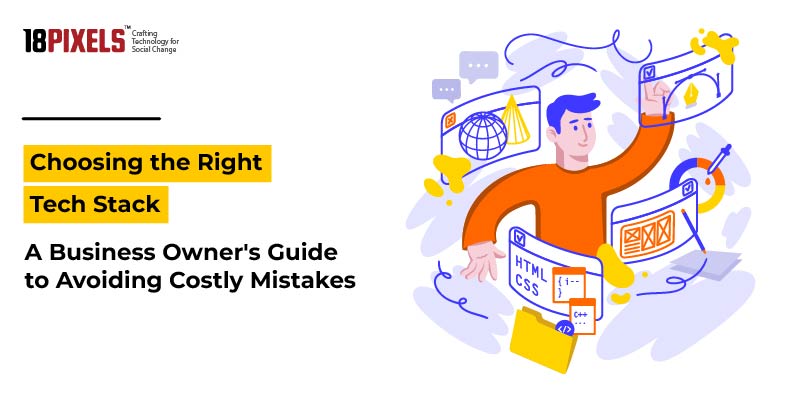

Choosing the right tech stack is one of the most defining, high-stakes decisions a business owner will make. It’s far more than an “IT problem”; it is the foundational blueprint of your entire digital presence. This decision is the digital DNA of your company, dictating your scalability, your speed to market, your hiring costs, and your ability to pivot. Get it right, and you create a flexible, powerful engine for growth. Get it wrong, and you’ll be shackled by technical debt, slow performance, and a constant drain on your budget.
As a non-technical founder or business owner, you don’t need to know how to write the code, but you must understand the strategic business implications of the technologies chosen. This guide will demystify the components, highlight the critical business questions to ask, and help you avoid the most common and costly mistakes.

What is a “Tech Stack,” Really? A Deeper Dive
Let’s stick with the house analogy. If your application is a house, your tech stack isn’t just the foundation—it’s the entire set of materials and systems used to build it. It’s the concrete, the plumbing, the electrical system, and the type of wood used for the frame.
A tech stack is typically layered, with each layer performing a specific job:
- The Frontend (The “Storefront” or “Interior Design”): This is everything your user sees and interacts with. It’s the user interface (UI) and user experience (UX).
- Core Technologies: HTML (the structure), CSS (the style), and JavaScript (the interactivity).
- Popular Frameworks: React (by Facebook), Angular (by Google), and Vue.js are the “power tools” that make building complex, interactive frontends much faster.
- The Backend (The “Engine Room” & “Plumbing”): This is the server-side logic that powers everything. It handles business logic, processes user requests, and communicates with the database. You users never see it, but they feel it when it’s slow or broken.
- Popular Languages/Frameworks: Node.js (JavaScript), Python (Django, Flask), Ruby (Ruby on Rails), PHP (Laravel), Java (Spring), C# (.NET).
- The Database (The “Secured Warehouse”): This is where all your critical data is stored—user profiles, product inventories, blog posts, etc.
- SQL (Relational): Highly structured, like an Excel spreadsheet. Great for data integrity (e.g., financial transactions). Examples: PostgreSQL, MySQL.
- NoSQL (Non-Relational): More flexible, like a folder of documents. Great for unstructured data and scaling horizontally (e.g., social media feeds). Examples: MongoDB, Cassandra.
- The Infrastructure (The “Land & Utilities”): This is the server and hosting environment that your entire application runs on.
- Server: The computer (or virtual computer) that runs your backend code.
- Hosting: Where your server “lives.” This is almost always a cloud provider like Amazon Web Services (AWS), Google Cloud Platform (GCP), or Microsoft Azure.

Why Choosing the Right Tech Stack is a Core Business Decision
Every technical choice has a direct and measurable business consequence. Here’s what’s at stake.
- Total Cost of Ownership (TCO): This is the single biggest area where owners get blindsided. The “cost” isn’t just the initial build. It includes:
- Developer Salaries: The single biggest factor. A React developer’s salary is different from a Ruby on Rails developer’s. A stack with a small talent pool means you pay a premium for experts.
- Licensing & Hosting Fees: Open-source tech is “free” to use, but proprietary software (e.g., certain Microsoft products or database solutions) can have hefty licensing fees. Cloud hosting costs can also balloon as you scale.
- Maintenance: Every stack requires security patches, updates, and bug fixes. A poorly chosen stack can lead to more “technical debt” (the implied cost of future rework), which strangles your ability to launch new features.
- Scalability and Performance: This is your ability to grow without breaking.
- Vertical Scaling: (Scaling “Up”) Making your existing server more powerful (more RAM, better CPU). This is easy and fast, but you will eventually hit a very expensive ceiling.
- Horizontal Scaling: (Scaling “Out”) Adding more servers to distribute the load. This is far more complex to set up but is how modern giants like Google and Netflix handle millions of users. Your tech stack must be architected to support horizontal scaling.
- Speed to Market (Time-to-Value): How fast can you get a Minimum Viable Product (MVP) in front of customers to validate your idea? Some stacks, like Ruby on Rails or Node.js, are famous for “rapid application development” because they have vast libraries of pre-built components.
- Security and Compliance: If you handle any sensitive data (payments, personal info, health records), your stack is your first line of defense. A stack with a strong security track record and an active community that releases patches quickly is non-negotiable. This directly impacts your ability to be PCI (payments), HIPAA (health), or GDPR (privacy) compliant.
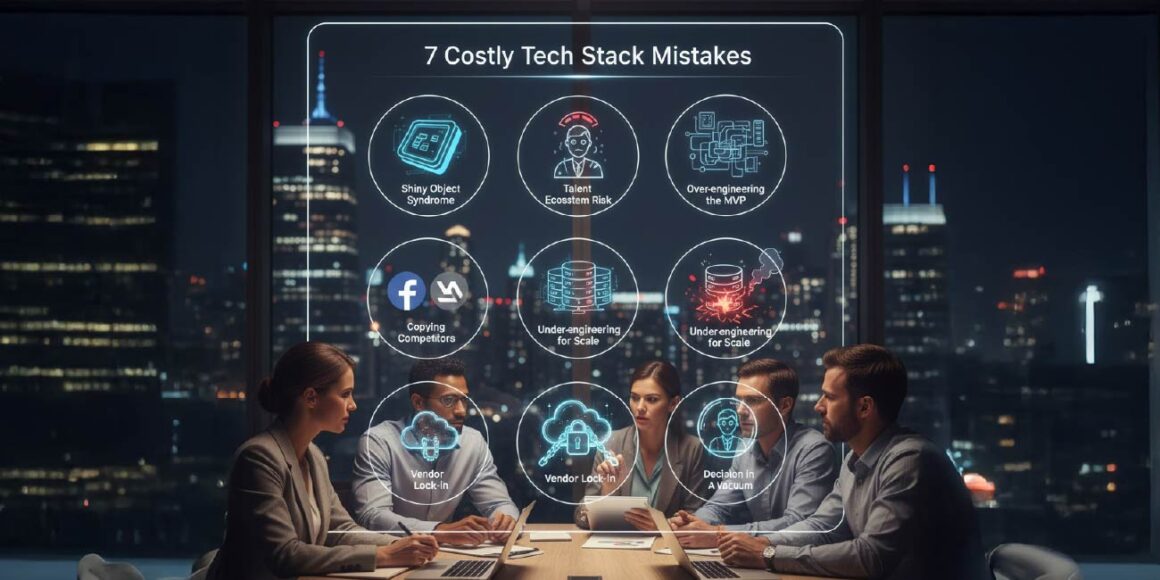
7 Costly Mistakes to Avoid (And What to Do Instead)
- The “Shiny Object” Syndrome: Your developer is excited about a brand-new, fast-growing framework.
- The Mistake: Building your core business on unproven, “bleeding-edge” tech. The community is small, bugs are undiscovered, and you may not be able to find anyone to fix it in two years.
- What to Do Instead: Prioritize “battle-tested” technologies that are mature and have a large, active support community.
- Ignoring the Talent Ecosystem: You choose a niche, powerful technology.
- The Mistake: You find one developer who knows it. That developer is now a single point of failure. When they quit or go on vacation, your business grinds to a halt.
- What to Do Instead: Before committing, do a quick LinkedIn search. How many developers in your city/country have this skill? A healthy talent pool (e.g., JavaScript, Python) means lower hiring costs and less risk.
- Over-engineering the MVP: Building a system for 10 million users when you don’t even have 10.
- The Mistake: You spend 12 months and $500k building a “perfectly scalable” system, only to find out customers don’t want your product.
- What to Do Instead: Build for your first 1,000-10,000 users. Optimize for learning and speed to market. A stack like Ruby on Rails or a simple LAMP setup is perfect for this.
- Under-engineering for Scale (The “Crash on Success” Problem): The opposite of #3
- The Mistake: Your app is built on a simple framework that can’t handle a sudden spike in traffic. You get featured in the news, your site crashes, and you lose thousands of potential customers.
- What to Do Instead: Ask your dev team, “What breaks first when we get 10x our traffic?” and “How do we scale horizontally?”
- Choosing a Stack Based on Your Competitor: “I heard Facebook uses React, so we should too.”
- The Mistake: You don’t have Facebook’s problems, budget, or legacy code. Their choice, which was right for them, may be disastrously wrong for you.
- What to Do Instead: Focus only on your project’s specific requirements.
- Getting “Vendor Lock-In”: Choosing a proprietary, all-in-one platform that “makes it easy.”
- The Mistake: These platforms are easy to start with but can be impossible to migrate away from. They control your data, your features, and your pricing.
- What to Do Instead: Strongly favor open-source technologies. This gives you the freedom to move your code to any developer or hosting provider you want.
- Letting One Person Make the Decision in a Vacuum: Your lead developer makes the choice without consulting the business strategy.
- The Mistake: They choose the stack they want to learn, not the stack the business needs.
- What to Do Instead: Use the framework below to make this a collaborative decision between technical and business leadership.
A Practical Framework for Choosing the Right Tech Stack
Use this 5-step process to guide the conversation with your CTO, technical co-founder, or development agency.
- Step 1: Define Business Goals & Project Scope.
- Is this a simple content-driven marketing site? (e.g., WordPress on a LAMP stack).
- Is this a data-heavy application with AI/ML features? (e.g., Python/Django).
- Is this a highly interactive, real-time single-page application (SPA)? (e.g., MERN stack).
- Is this a large-scale enterprise system handling complex transactions? (e.g., Java/Spring or .NET).
- Step 2: Identify Your “Non-Negotiables.”
- Performance: Does your app need to be “real-time” (like a chat app) or is a 2-second page load acceptable?
- Security: Are you handling payments (PCI) or health data (HIPAA)?
- Time-to-Market: Is launching an MVP in 3 months the most important goal?
- Step 3: Compare Popular, Proven Stacks.
Don’t reinvent the wheel. Most projects fall into a few common categories. Here are the most popular “go-to” stacks:- LAMP Stack (Linux, Apache, MySQL, PHP):
- What it is: The original workhorse of the web. Powers over 75% of the internet (thanks to WordPress).
- Best for: Content-heavy sites, blogs, standard e-commerce (WooCommerce, Magento), and projects with a predictable structure.
- MERN Stack (MongoDB, Express.js, React, Node.js):
- What it is: An all-JavaScript stack. Its key advantage is using one language (JavaScript) for both the frontend and backend.
- Best for: Modern SPAs, real-time applications, and projects where frontend interactivity is key.
- Python + Django/Flask:
- What it is: A powerful, readable backend language (Python) with a “batteries-included” framework (Django) or a minimalist one (Flask).
- Best for: Data science, AI/ML integrations, scientific computing, complex backend logic, and robust security.
- Ruby on Rails (RoR):
- What it is: A framework built on the Ruby language, designed for “developer happiness” and extreme speed in development.
- Best for: Rapid prototyping (MVPs). Startups love it for this reason. (e.g., GitHub, Airbnb, and Shopify were all built on Rails).
- LAMP Stack (Linux, Apache, MySQL, PHP):
- Step 4: Audit Your Team and Budget.
- What does your current team know? The fastest stack is often the one your developers are already experts in.
- What is your real budget (including TCO)? A “free” open-source stack run by expensive, in-demand developers may cost more than a licensed stack with a cheap, abundant talent pool.
- Step 5: Prototype & Validate.
- If you’re torn between two options, ask a small team (or even a single developer) to build a “proof of concept” (PoC) for a single, small feature in both stacks. This “Day 1” test can reveal more about scalability and development speed than weeks of a theoretical debate.

Your Tech Stack is a Business Asset, Not an IT Checklist
Choosing the right tech stack is a foundational, strategic decision that will echo through your company’s life for years. It’s not a one-time choice to be delegated and forgotten.
By translating technical jargon into business trade-offs—Cost vs. Speed vs. Risk—you can be an active, informed participant in this crucial conversation. Don’t pick the “best” tech stack; pick the right tech stack for your specific business, your specific budget, and your specific goals.
Build your digital future on the right foundation. Get expert guidance now →
FAQs
A tech stack is the combination of tools, frameworks, and technologies used to build a website or application.
It impacts your app’s speed, scalability, security, and overall development cost.
Consider your project goals, budget, scalability needs, and developer availability before deciding.
For most startups, MERN, LAMP, or Python/Django stacks are popular due to flexibility and scalability.
Using untested technologies, ignoring scalability, and copying competitors’ stacks are common errors.
Yes, but migrating stacks can be time-consuming and costly. It’s best to validate choices early.
Frontend handles user interface and experience, while backend manages data, logic, and server-side functions.
Open-source is usually preferred for flexibility, community support, and cost efficiency.
A well-chosen stack supports both vertical and horizontal scaling as your user base grows.
Yes. Even without coding knowledge, understanding business goals helps make informed tech choices.
Don’t stop here—discover more in our latest blog –
Full-Stack Web Development in 2025: Technologies Every Business Should Know
How UI/UX Design Directly Impacts Conversion Rates: Real Data, Real Examples
Top 10 Web Development Mistakes That Hurt SEO – And How to Fix Them
Post Views: 220