
Generative AI in software is redefining how modern applications are designed, built, and scaled. Generative AI in software enables systems to generate content, automate decisions, and continuously improve user experiences—but without the right safeguards, it can introduce bias, compliance risks, and reputational damage.
As businesses accelerate toward AI-first products, understanding where Generative AI adds value—and where it creates risk—is critical.
Understanding Generative AI in Software Applications
What Generative AI Means for Modern Software
Generative AI in software refers to embedding AI models capable of producing original outputs—such as text, code, recommendations, or insights—directly into applications and workflows. Unlike traditional rule-based automation, Generative AI adapts to context, learns from data, and evolves over time. This flexibility allows software to move beyond static logic into intelligent, self-optimizing systems.
From customer-facing chatbots to internal decision-support tools, Generative AI is becoming a foundational layer of digital products.
Opportunities of Generative AI in Software
Accelerating Product Development and Innovation
One of the most significant advantages of Generative AI in software is faster development cycles. AI-assisted coding tools help developers write cleaner code, detect vulnerabilities, generate tests, and reduce technical debt. This allows engineering teams to focus on architecture and innovation instead of repetitive tasks, leading to quicker go-to-market timelines.
For startups and enterprises alike, this translates into lower development costs and faster experimentation.
Intelligent Automation Across Business Workflows
Generative AI in software enables end-to-end automation across departments. AI can analyze inputs, generate responses, and trigger actions without human intervention. When integrated with workflow automation systems, Generative AI can manage customer support, data processing, report generation, and operational decision-making at scale.
This level of automation improves efficiency while reducing manual errors.
Enhanced User Experience Through Personalization
Modern users expect software to adapt to their needs. Generative AI enables personalized content, contextual recommendations, and conversational interfaces that feel human-like. Software powered by Generative AI can understand intent, predict behavior, and respond dynamically—creating more engaging and intuitive user experiences.
Personalization driven by AI directly impacts retention, satisfaction, and conversion rates.
Risks Associated with Generative AI in Software
AI Governance Challenges and Accountability Gaps
A major pain point with Generative AI in software is unclear governance. Many organizations deploy AI models without defining who owns the outcomes, how decisions are monitored, or how failures are handled. This lack of accountability can quickly escalate into compliance violations or legal exposure, especially when AI influences customer-facing decisions.
Without a governance framework, AI becomes a black box rather than a controlled system.
Bias, Ethics, and Fairness Concerns
Generative AI models are trained on large datasets that often contain hidden biases. When these models are embedded into software, they can unintentionally reinforce discrimination or unfair outcomes. In industries like finance, hiring, and healthcare, biased AI decisions can result in serious ethical and legal consequences.
Responsible use of Generative AI requires continuous bias testing and ethical oversight.
Regulatory and Compliance Risks
As governments introduce stricter AI regulations, Generative AI in software must comply with evolving legal frameworks. Non-compliance can lead to fines, forced shutdowns, or reputational damage. Businesses operating in regulated sectors face even greater risks if AI outputs cannot be audited or explained.
Regulation is no longer a future concern—it is a present-day reality.
Reliability and Hallucination Risks
Generative AI systems can generate responses that appear accurate but are factually incorrect. These hallucinations are particularly dangerous when AI is used for analytics, recommendations, or decision support. If unchecked, incorrect outputs can mislead users and undermine trust in the software.
AI reliability must be continuously validated.
Responsible AI: Best Practices for Safe Implementation
Human-in-the-Loop Decision Making
To reduce risk, Generative AI in software should support—not replace—human judgment. Human-in-the-loop systems ensure that critical decisions are reviewed, validated, and approved by people. This approach balances automation with accountability, especially in high-impact use cases.
Human oversight is a cornerstone of responsible AI.

Explainability and Transparency in AI Systems
Software using Generative AI must be able to explain how decisions are made. Explainable AI allows organizations to trace outputs back to inputs, logic, and data sources. This transparency is essential for audits, compliance, and user trust.
If AI decisions cannot be explained, they should not be deployed in sensitive systems.
Data Privacy and Security by Design
Generative AI in software must be designed with privacy as a core principle. Sensitive data should never be exposed to unsecured or public models. Enterprises increasingly adopt private or hybrid AI deployments to maintain control over data and comply with privacy regulations.
Secure AI architectures protect both users and businesses.
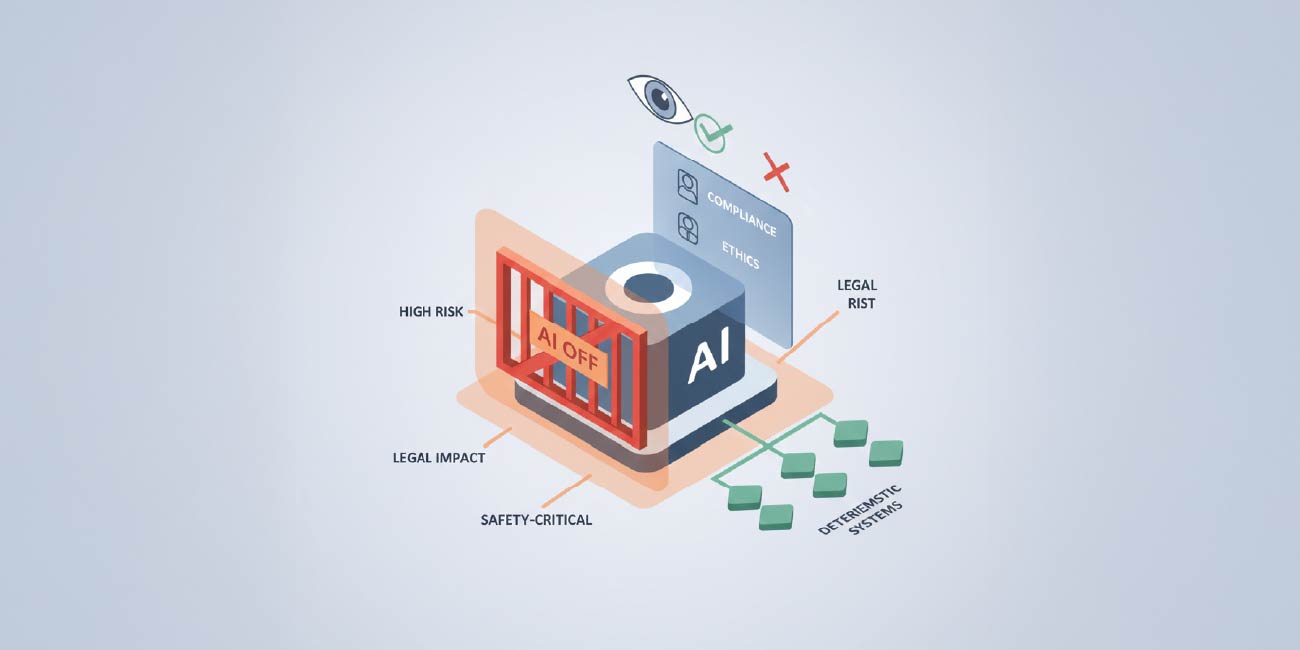
When Generative AI Should Not Be Used
Avoiding AI in High-Risk, High-Accuracy Scenarios
Not every problem requires Generative AI. In scenarios where accuracy, safety, or legal certainty is non-negotiable, traditional deterministic systems may be a better choice. Overusing AI can lead to unnecessary risk and public backlash.
Knowing when not to use AI is just as important as knowing when to use it.
2026 Best Practices for Generative AI in Software
Building AI Governance Frameworks
By 2026, organizations will need clear AI governance structures defining acceptable use, risk categories, and accountability. Governance frameworks ensure AI systems align with business goals, ethics, and regulations.
AI without governance will not scale sustainably.
Designing Modular and Flexible AI Architectures
Future-ready software will treat AI as a modular component. This allows models to be upgraded, replaced, or disabled without disrupting the entire system. Modular AI architecture reduces vendor lock-in and improves long-term adaptability.
Flexibility is key to AI longevity.

Prioritizing Ethical and Auditable AI
Ethical AI audits, transparency reports, and compliance reviews will become standard practice. Businesses that proactively invest in responsible AI will gain customer trust and regulatory confidence.
Responsible AI will be a competitive advantage—not just a requirement.
Generative AI in software is a powerful tool that can transform products, processes, and customer experiences. However, without governance, ethics, and transparency, it can expose organizations to serious risks. The future belongs to companies that embed AI responsibly—leveraging its strengths while respecting its limitations.
FAQs:
Generative AI in software uses AI models to create content, code, insights, or responses directly within applications.
It helps businesses automate workflows, improve efficiency, personalize user experiences, and reduce costs.
Key risks include bias, inaccurate outputs, lack of transparency, data privacy issues, and regulatory non-compliance.
By applying AI governance, human oversight, explainable models, and secure data practices.
Yes, if properly monitored, tested, and transparently disclosed to users.
Yes, if trained on biased data, which is why continuous monitoring is essential.
Avoid using it in high-risk scenarios requiring 100% accuracy or legal certainty.
No, it supports humans by automating tasks and providing insights.
It can be compliant when implemented with governance, audits, and privacy controls.
The future focuses on responsible, transparent, and governed AI adoption by 2026.
Don’t stop here—discover more in our latest blog –
Full-Stack Web Development in 2025: Technologies Every Business Should Know
How UI/UX Design Directly Impacts Conversion Rates: Real Data, Real Examples
Mobile-First or Mobile-Last? Why 62% of Your Traffic Demands a Mobile-Optimized Website
Post Views: 249